25 Canadian Tax Acronyms Every Business Owner Should Know

A plain-English guide for CCPC owners and the advisors who serve them. 25 terms, 5 planning themes.
Why it matters: tax jargon costs business owners money
These acronyms drive how your corporation is taxed, how you pay yourself, and how you exit. Know them, and your conversations with your advisor get sharper. They touch three big decisions:
- Compensation: salary vs. dividends
- Investment: passive income inside your company
- Succession: selling or passing on the business
Theme 1: Corporate structure, where it all starts
- CCPC (Canadian-Controlled Private Corporation): A private Canadian corporation that meets specific ownership and control tests. Status unlocks small-business tax rates and other benefits.
- SBD (Small Business Deduction): Reduces the federal tax rate on qualifying active business income, generally up to a $500,000 annual business limit.
- ABI (Active Business Income): Income from carrying on an active business, generally excluding investment businesses and personal services businesses.
Theme 2: Investment income, where passive income can shrink your small business limit
- AII (Aggregate Investment Income): A tax-defined measure of certain corporate investment income, including taxable capital gains and property income. Drives refundable tax calculations.
- AAII (Adjusted Aggregate Investment Income): Determines whether passive income reduces your small business limit.
$50,000 AAII is where the federal small-business limit starts shrinking. $150,000 AAII is where the $500,000 limit is fully eliminated.
Refundable tax: tax you may get back
RDTOH was split into two accounts for tax years beginning after 2018.
- RDTOH (Refundable Dividend Tax on Hand): Tracks certain refundable taxes that may be recovered when the corporation pays taxable dividends.
- ERDTOH (Eligible RDTOH): Generally tied to Part IV tax on eligible dividends received. Refunds can come from eligible or non-eligible dividends, subject to ordering rules.
- NERDTOH (Non-Eligible RDTOH): Generally tracks refundable tax on passive investment income and certain non-eligible dividends. Refunds generally require non-eligible dividends.
What losing the SBD could cost you
Extra corporate tax on $500,000 of active business income if the small-business limit is fully eliminated (AAII of $150,000+):
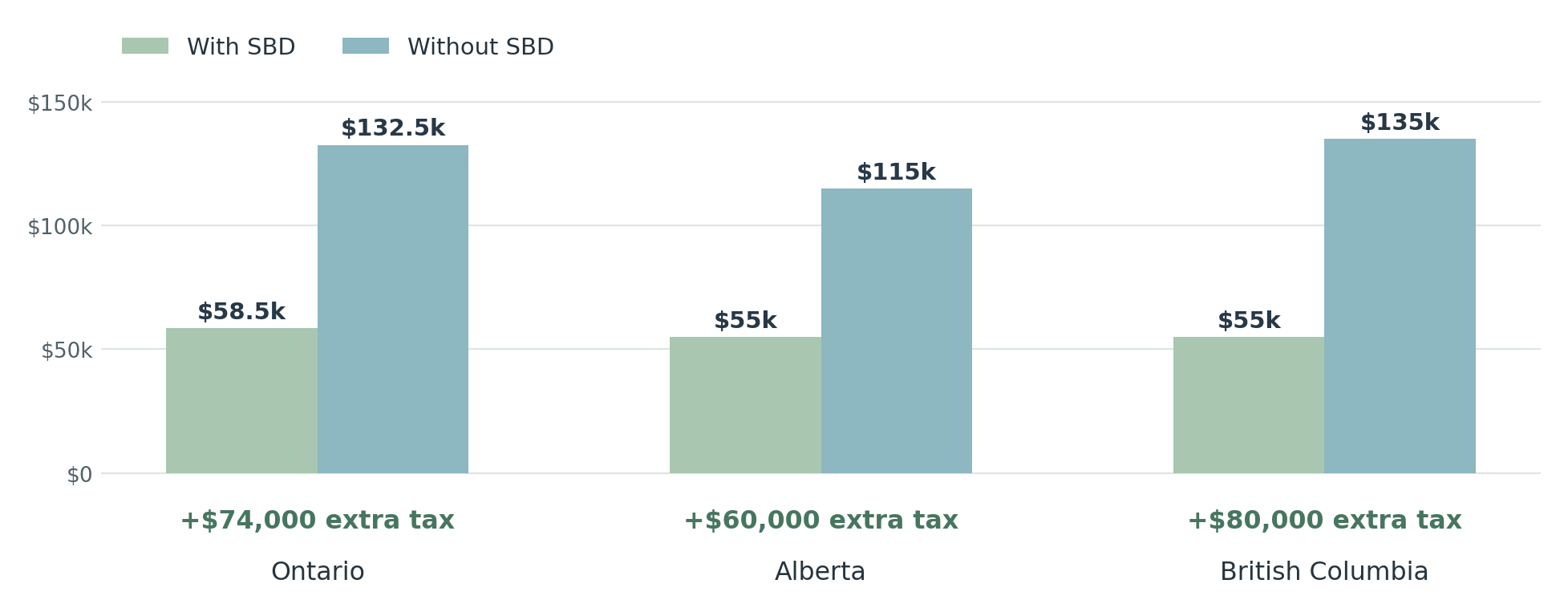
- Ontario: +$74,000 extra tax
- Alberta: +$60,000 extra tax
- British Columbia: +$80,000 extra tax
Combined federal + provincial 2026 rates. With SBD: ON 11.7% (calendar-year blend), AB 11%, BC 11%. Without SBD: ON 26.5%, AB 23%, BC 27%. Illustrative purposes only. Chart is not tax advice. Rates, limits and eligibility vary and change; review your situation with your tax advisor.
Theme 3: Dividend planning, eligible vs. non-eligible dividends
The type of dividend you pay changes the after-tax result for shareholders.
- GRIP (General Rate Income Pool): Tracks a CCPC's capacity to pay eligible dividends, generally from income taxed at general corporate rates.
- LRIP (Low Rate Income Pool): Mainly relevant to non-CCPCs; restricts eligible dividend payments until certain low-taxed balances are addressed.
- CDA (Capital Dividend Account): A notional account that can permit tax-free capital dividends to Canadian-resident shareholders (e.g., the non-taxable portion of capital gains, qualifying life insurance proceeds).
- DTC (Dividend Tax Credit): A personal credit recognizing corporate tax already paid on profits paid out as taxable dividends. Different calculations for eligible and non-eligible dividends.
Theme 4: Capital gains, valuation and succession
The valuation trio
Three numbers sit behind every sale, share redemption, and estate freeze.
- ACB (Adjusted Cost Base): The tax cost of an asset, used to calculate gains or losses.
- PUC (Paid-Up Capital): The tax-recognized capital associated with shares. Critical for estate freezes and share redemptions.
- FMV (Fair Market Value): The price an asset would command between informed, independent parties. Central to business valuations and deemed dispositions at death.
Selling or passing on the business
- LCGE (Lifetime Capital Gains Exemption): Lets qualifying individuals shelter eligible capital gains on certain business shares and farm or fishing property.
- QSBC (Qualified Small Business Corporation shares): Shares must meet ownership, asset-use, and holding-period tests to access the LCGE.
- ITB (Intergenerational Business Transfer): Special rules that can give capital gains treatment (instead of dividend treatment) on qualifying transfers to children or grandchildren.
Plan for QSBC status years before a sale.
Losses and limits: watch the fine print on gains and losses
- CNIL (Cumulative Net Investment Loss): Tracks certain net investment losses and can reduce the capital gains eligible for the LCGE. Watch it if you've borrowed to invest.
- ABIL (Allowable Business Investment Loss): A portion of a business investment loss that may be deducted against income beyond capital gains, subject to conditions.
- AMT (Alternative Minimum Tax): A parallel personal tax calculation that can add tax when large capital gains, deductions or credits are involved. Especially relevant to estate and charitable planning after the 2024 reforms.
Theme 5: Assets and compliance, deductions, credits and guardrails
- CCA (Capital Cost Allowance): The tax deduction for depreciable assets such as equipment, buildings, and vehicles, based on prescribed classes and rates.
- UCC (Undepreciated Capital Cost): The remaining tax balance of an asset class after additions, dispositions, and CCA. Relevant to recapture and terminal losses.
- ITC (Investment Tax Credit): A credit for qualifying expenditures, including certain scientific research, development, and clean-technology investments.
- GAAR (General Anti-Avoidance Rule): Can deny tax benefits from transactions considered abusive, even if each technical rule appears satisfied.
The big picture: 25 acronyms, 5 planning themes
- Corporate Structure: CCPC, SBD, ABI
- Investment Income: AII, AAII, RDTOH, ERDTOH, NERDTOH
- Dividend Planning: GRIP, LRIP, CDA, DTC
- Capital Gains & Succession: LCGE, QSBC, ACB, PUC, FMV, CNIL, ABIL, ITB, AMT
- Assets & Compliance Planning: CCA, UCC, ITC, GAAR
Which acronym do you wish you'd understood sooner?
Mastering these terms helps you ask better questions, make proactive compensation and investment decisions, and protect the value you've built.
Book a conversation with your advisor.
For general information only. Canadian tax law is complex and subject to change. Consult a qualified tax professional before acting.